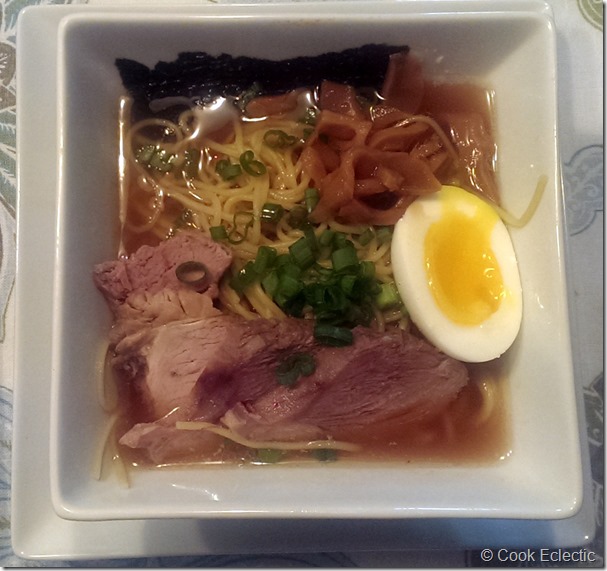
Hello world! That’s how I’m supposed to start this thing, right? Well, anyhow, my long-awaited (by no one in particular… except maybe my mom. Hi Mom!) food blog has finally arrived. Since this recipe seemed to attract a lot of interest on Facebook recently, I thought it would make a suitable foray into the foodblogosphere. And only 10 years after blogging became a thing!
You may have noticed that ramen is trendy right now. I literally got 100 pages of results when I searched for ramen in San Francisco on Yelp a second ago, though that may also be an indicator of a flawed search algorithm on Yelp’s end. But ramen is in full food fad swing, to the point where even NPR is doing human interest stories about it. Now, I don’t necessarily embrace all food fads (I’m looking at you, kale), but, since I’m a fan of even the instant, bad-for-you kind of ramen, I’ve been considering making the good stuff at home for a while. However, because of the ingredients (many of which require a Japanese grocery or online purchase) and the time to make it (two days) I had put it off until the summer, the official period in which I attempt ambitious cooking projects.
I tend to obsessively thoroughly research any recipe that’s completely new to me, and the internet is certainly full of advice on ramen. I did appreciate the 7000-word screed at Serious Eats, which helped me narrow my focus. Though the trendiest of the ramens at the moment is probably tonkotsu, I felt like the one I wanted to try first was shoyu, or ramen flavored with soy sauce, since it is more similar to my mental image of ramen. Plus, by going with shoyu I didn’t have to figure out where I’d get pigs trotters around here (Mexican grocery? Probably. Next summer.). I looked at quite a few shoyu ramen recipes and the one I went with (see below) seemed reasonably authentic without being overly complicated (well, comparatively speaking).
Luckily, I had some of the Japanese ingredients I needed already from making dashi, which is a key part of many Japanese recipes, including the rice bowls I like to make occasionally for quick weeknight dinners (future post??). In our house, dashi is also known as “stinky fish broth,” since opening the bag of bonito flakes will definitely draw the attention of every cat in the neighborhood. I got the kombu and bonito for my dashi from here, which has MUCH better prices than my usual go-to for pretty much everything, Amazon. I got the remaining ingredients from a local Japanese grocery store. Sadly, my local store didn’t have fresh ramen noodles, but they did have the “real” dry kind— as in, not fried like the instant kind (ever wonder why instant ramen has so much fat? they dry it by flash frying it). If you are even more ambitious than I am, you could try making the noodles yourself.
At this point, you may be asking yourself, “Is it really worth it to go to all this trouble?” Yes! This is one of the most delicious dishes I have ever made. The star is the broth. Rich, silky. Decadent is really the best word to describe it. And the many garnishes are just the proverbial icing on the cake. You won’t be disappointed.
I’m including pictures and descriptions of the Japanese ingredients here, so you have an idea what you are looking for.
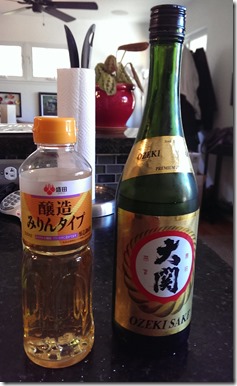
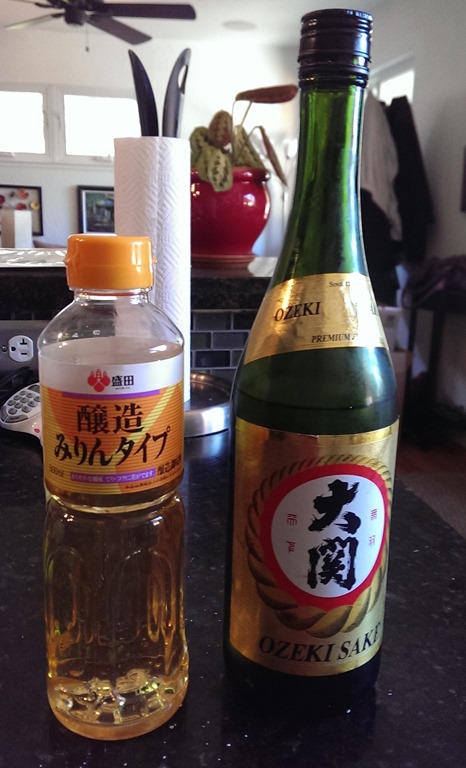
Mirin (rice cooking wine) and sake
Though I always try to follow the “Only cook with alcohol you’d drink” mantra, it’s much more difficult with foreign ingredients! This mirin is the salted “cooking” kind because the real kind is difficult to find (though, too late, I found that you actually can get some on Amazon). The sake was a mid-priced one from the store. I tasted it and it seemed okay to my not-sake-trained palate.
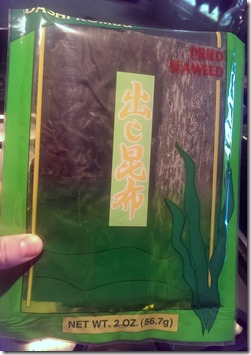
Kombu, for making broth (dashi)

Bonito (aka “stinky fish”) flakes
Kombu is a very thick, kelp-like seaweed. For the bonito, make sure to get the people kind. Many of the bags on Amazon were being marketed as cat treats.
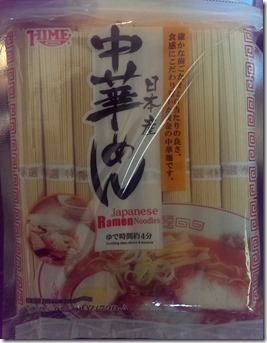
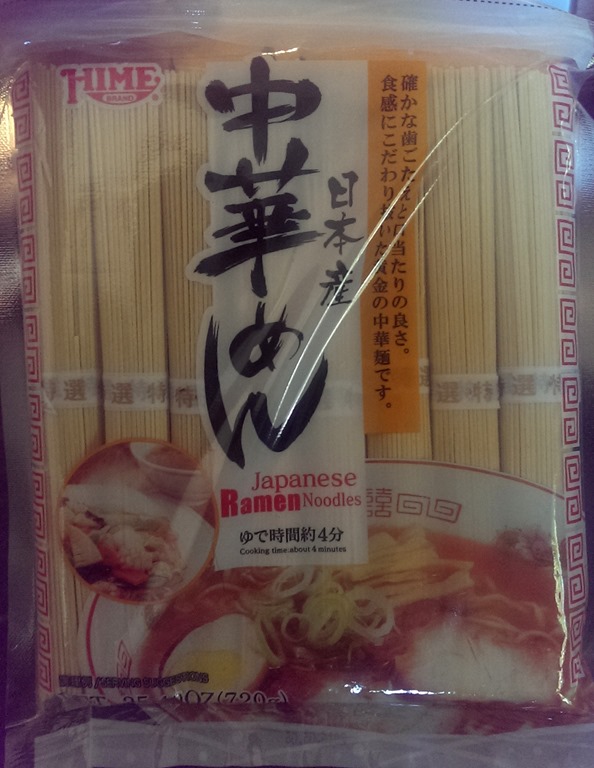
Ramen noodles (chukamen)
Get fresh ramen noodles if you can, but these dry chukamen noodles are a good second choice. In a pinch, you could use instant ramen (but toss out the flavor packet, obviously). This brand conveniently has each one-person serving wrapped up separately.
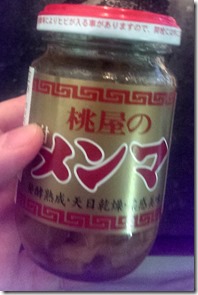
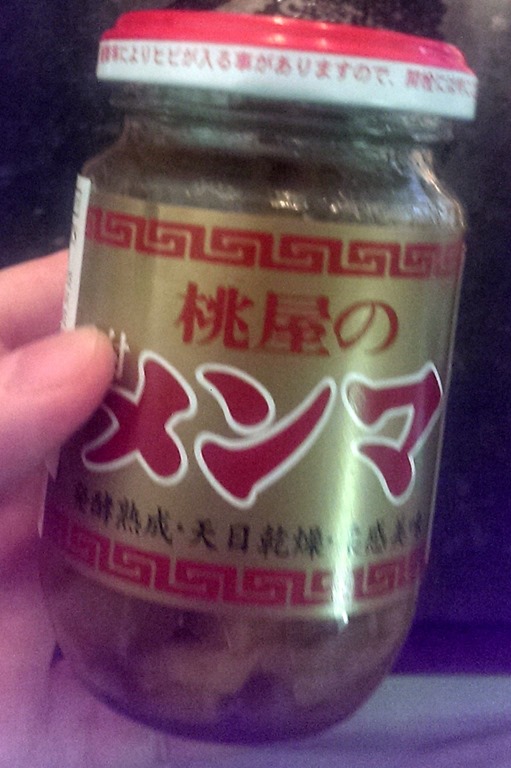
Menma (fermented bamboo shoots)
The word “fermented” can scare some people off. Rest assured, the previously skeptical members of my household all agree that menma is actually delicious.
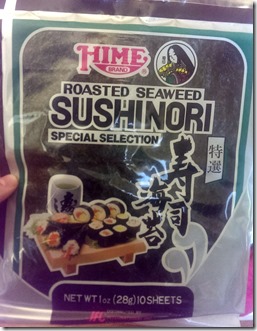
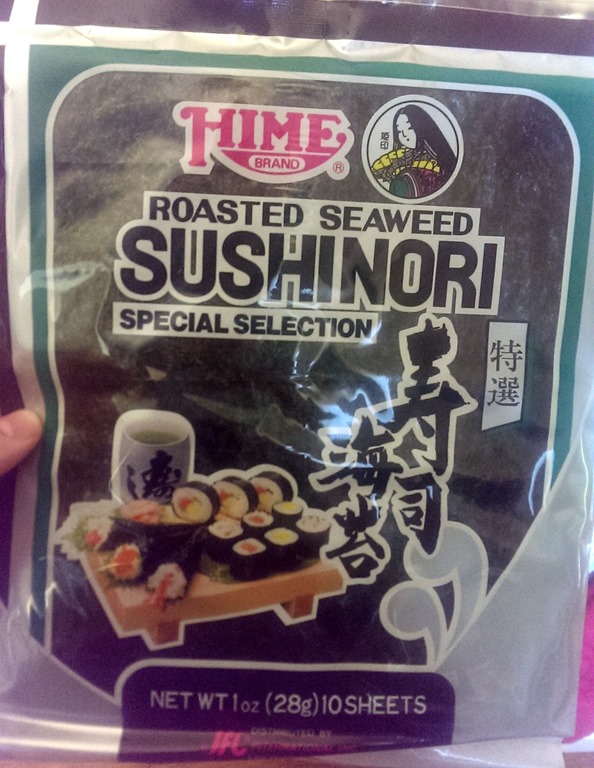
Nori (toasted seaweed)
This thin, sushi type of seaweed is the one Japanese ingredient that’s easy to find (for me, anyways). My normal Safeway had it.
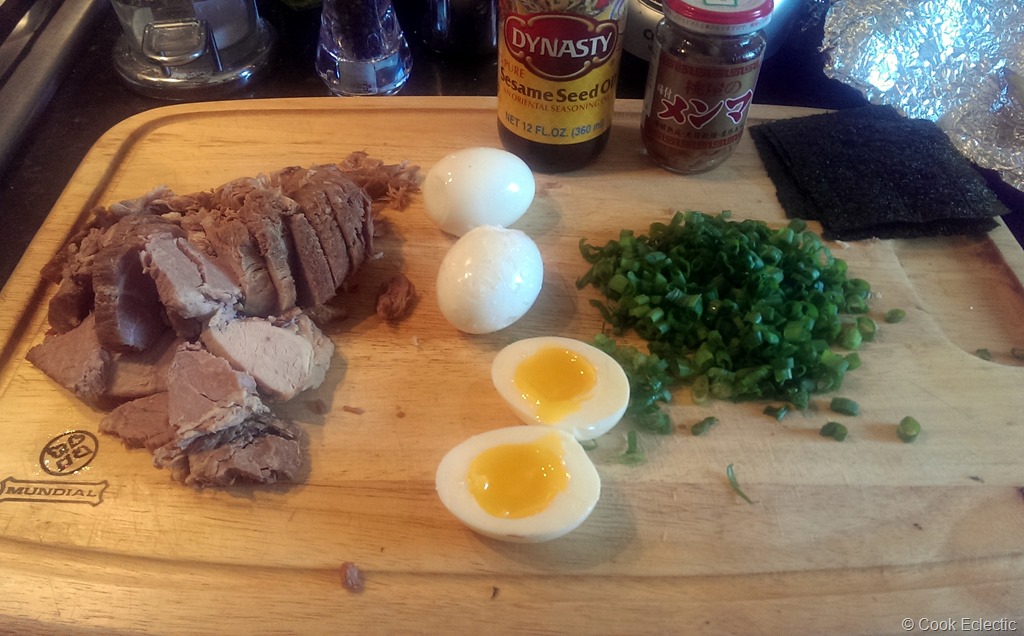
Pictured below: sesame oil (you probably already have that, right?). Not pictured: shichimi togarashi, which I forgot to buy so we didn’t use (oops).
The whole process takes two days, but keep in mind that the first day’s much longer and more labor intensive than the second day (unless you are planning on making your own noodles). Overall, on Day 1 you will be making your stock, and on Day 2 you will be putting together your garnishes. Ramen is all about the garnishes!
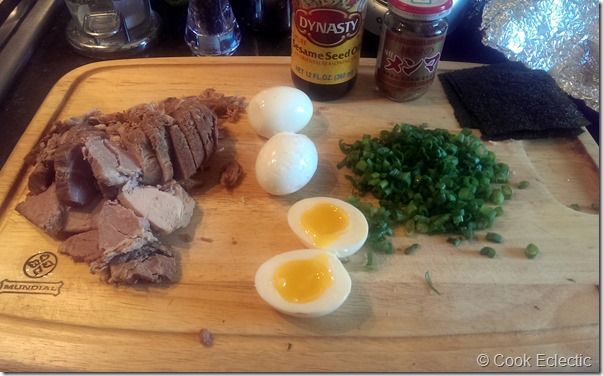
Behold, the garnishes.
Shoyu Ramen
Adapted from Bon Appetit
Active time: 1 hour; Inactive time: 4 hours; Total time: 2 days; Servings: 6
Ingredients
Day 1:
1/2 C soy sauce
2 TB sake
1 TB mirin
2 large pieces kombu
2 TB vegetable oil
2 lb pork shoulder (boneless if possible), tied with cooking twine
1.5 lb pork ribs
2 lb chicken necks, backs, or wings (I used wings)
2 bunches scallions, roughly chopped
2 carrots, peeled and cut in large chunks
1 head of garlic, halved horizontally
2” piece ginger, peeled
1/4 C bonito flakes
Day 2:
3 large eggs
6 servings ramen noodles (approx. 30 oz fresh or 18 oz dry)
1 5 oz. jar menma
6 scallions, thinly sliced
3 sheets nori, torn in half
Sesame oil
Shichimi togarashi
Directions
Day 1:
- Mix together soy sauce, sake and mirin in a small container. Cover and chill. (This is the tare. It will be mixed with the broth tomorrow.)
- Pat the pork shoulder dry with paper towels and season well with salt on all sides. Set aside. Repeat with the ribs. Sprinkle a pinch of salt over your chicken pieces too.
- Place the kombu in a large pot with one gallon of water. Allow to soak at room temperature for at least 30 minutes. Heat over high heat until small bubbles appear on the sides of the pot, then remove from heat and allow to soak for at least another 30 minutes. This is the kombu dashi (dashi means broth in Japanese).
- When the dashi is almost ready, heat the oil in the bottom of a large stock pot until it shimmers. Brown the pork shoulder well on all sides and set aside, then brown the pork ribs and set aside.
- Remove the kombu from the dashi and discard the kombu. Add the dashi to the stock pot with the oil.
- Add the pork shoulder, ribs, chicken, scallions, carrots, garlic, ginger, and bonito flakes to the dashi in the stock pot. Bring to a boil then reduce to a simmer.
- After the stock has been simmering for about an hour, check for seasoning. You will be adding soy sauce at the end of the cooking process tomorrow, so although you don’t want it to be bland now, err on the side of undersalting if you’re not sure.
- Simmer for 2 more hours (total 3 hours). Remove the pork shoulder, allow it to cool, then wrap and refrigerate. At this point you should have about half the original amount of liquid. Continue simmering, if necessary, after removing the shoulder until you have about 2 quarts of liquid left.
- Fill your sink with ice water. Place an empty pot in the ice and strain the stock through a large mesh strainer (I bought this just for making stock) into the pot in the ice bath. This is much easier with two people! Discard all the stuff you strained out (I snacked on the rib meat since it seemed like a waste. Overcooked, but delicious!)
- After the stock has cooled and melted all your ice, cover and place in the fridge overnight. (In case you’re wondering, the ice bath is to ensure faster cooling to avoid making the stock a petri dish for food poisoning.)
Day 2:
- Bring a large pot of water to a boil. Carefully add all three eggs and cook for 7 minutes, then use a strainer to transfer them immediately to an ice bath to stop the cooking. You want an egg with a solid white and a slightly gooey yolk. Don’t toss the water—you can use it to cook the pasta in too.
- Take your stock from the fridge. There will be a thick layer of fat on the top, and the stock itself will have the consistency of soft jello from the gelatin in the bones. If this were chicken stock you’d remove all the fat, but ramen broth is supposed to be a bit fatty… so remove most of the cooled fat and toss in the trash, leaving as much as you are comfortable with.
- Bring the stock to a low simmer over medium heat. Add the tare and check for seasoning.
- Take the cooled pork shoulder from the fridge, remove string, and slice thinly.
- Bring the large pot of water to a boil for the noodles. Don’t cook the noodles until your garnishes are ready, since they cook quickly.
- While waiting for the water to boil, peel the cooled eggs and slice in half lengthwise, slice your scallions, and prepare the other garnishes.
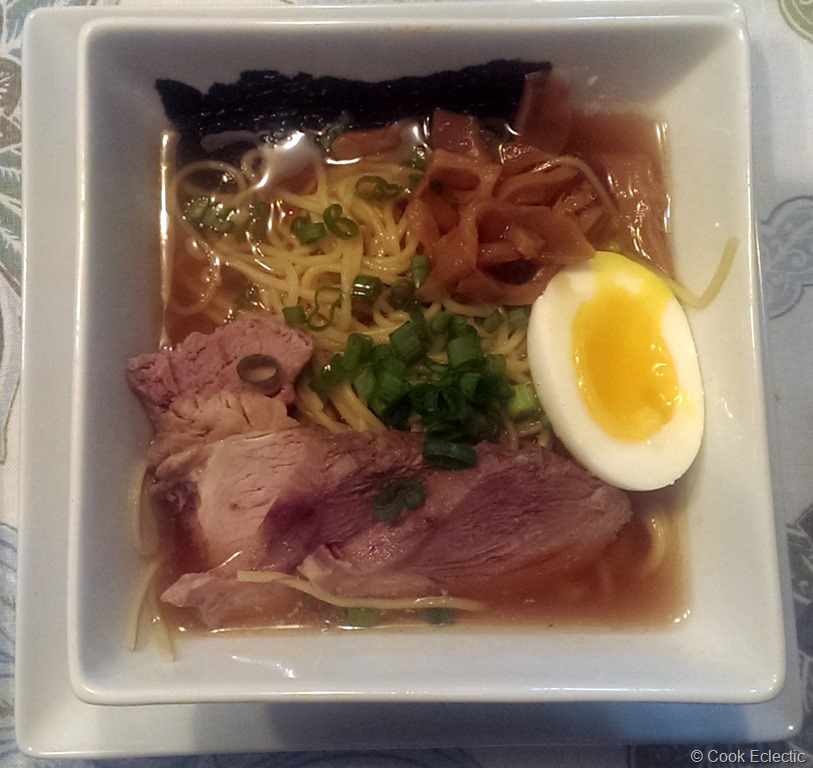
- Cook your noodles as directed, then split servings into deep bowls. Top with pork, then ladle the hot broth over the pork and noodles. Tuck the nori down the side of the bowl. Arrange a half egg and small pile of menma next to the pork, sprinkle with scallions, then top with splash of sesame oil and a sprinkle of shichimi togarashi.
- Serve right away and slurp!



 Cook Eclectic